Other Blogs


PLEASE VISIT MY OTHER 2 BLOG
The Naked Truth in a Confused World:  http://thenakedtruthinaconfusedworld.blogspot.ca/
Stories; very short, short and long: http://greyliteratureandlinguistics.blogspot.ca/
Showing posts with label Junta. Show all posts

Wednesday, September 23, 2015

EGYPT: After 122 days of forced disappearance, Islam has floated

SHAME, SHAME, SHAME

After 122 days of disappearance during which he did not have a single shower, his brother, Nour describes the torture his brother, 26 years old Islam received.

Nour says that his brother was subjected to different type of torture including but not limited to beatings and electric shocks.  He also said that the 26 years old Islam looks now like someone whose age is 100 years.

Egypt: Dozens of disappeared civilians face ongoing torture at military prison

Dozens of civilians have been subjected to enforced disappearance and held for months in secret detention at an Egyptian military camp, where they are subjected to torture and other ill-treatment to make them confess to crimes, according to shocking new evidence gathered by Amnesty International.

Egyptian lawyers and activists have a list of at least 30 civilians who are reportedly being held in secret at Al Azouly prison inside Al Galaa Military Camp in Ismailia, 130km north-east of Cairo. Former detainees there have told Amnesty International that many more – possibly up to 400 – could be held in the three-storey prison block. The detainees have not been charged or referred to prosecutors or courts, and have had no access to their lawyers or families.

“These are practices associated with the darkest hours of military and Mubarak’s rule. Egypt’s military cannot run roughshod over detainees’ rights like this,” said Hassiba Hadj-Sahraoui, Middle East and North Africa Programme Deputy Director at Amnesty international. The authorities must immediately inform the families and lawyers of all those being held in secret at Al Galaa Military Camp or elsewhere. Anyone who has been forcibly disappeared must immediately be granted access to doctors, lawyers and their families. They must be protected from further torture or other ill-treatment, and released, unless they are promptly charged with a recognizable criminal offense before being brought before a judge for a fair trial. “Reports of torture in Egypt have been steadily emerging. Yet, what’s happening inside the prison is taken straight from a torturer’s textbook and shows that behind the authorities’ rhetoric of the road map to democracy and upcoming elections lies ruthless repression,” said Hassiba Hadj-Sahraoui. There must be full, impartial and independent investigations into all allegations of torture and ill-treatment, with all those responsible brought to justice. Amnesty International met with recently released detainees from Al Azouly prison. They gave harrowing accounts of torture, including the use of electric shocks, burns and other ill-treatment during interrogations at the military camp.Lawyers and activists have told Amnesty International that enforced disappearances have been on the rise in Egypt since November 2013. It is expected that the detainees being held in secret will be brought before state security prosecutors after they have “confessed” under torture. In some cases, it appears that individuals have been secretly detained for months, during which time they were tortured to extract “confessions”. Lawyers working on state security cases, including those involving prisoners at Al Azouly, described a systematic pattern where people are abducted from streets or their homes and sent to Al Azouly, where they have no access to lawyers or their families and the authorities refuse to acknowledge that they were in custody. The defendants are coerced to “confess” to a crime or implicate others. Some of the detainees agree to confess once referred to the state security prosecutor, to get out of the prison and stop the torture. Lawyers told Amnesty International that they are never allowed to attend the first investigation and they are not informed about the date or time of the investigation. “Torture is absolutely prohibited under all circumstances and is a crime under international law. Prosecutors, courts and other Egyptian authorities must never use ‘confessions’ or statements extracted through torture or other ill-treatment in any proceedings. Imprisonment on such a basis constitutes arbitrary detention,” said Hassiba Hadj-Sahraoui.

Testimonies/cases

One prisoner released from Al Azouly military prison: “The military arrested me in January [2014]…and took me on the same day to Al Azouly prison after they beat me in a military camp in my town for four hours. I was held in Al Azouly prison for 76 days without seeing a judge or a prosecutor, I was not even allowed to talk to my family. They put me on the third floor of the prison in solitary confinement. The authorities there interrogated me six times. They took off my clothes and gave me electric shocks all over my body during the investigations, including on my testicles, and beat me with batons and military shoes. They handcuffed me from behind and hung me on a door for 30 minutes. They always blindfolded me during the investigations. In one interrogation they burned my beard with a lighter. The investigations were held in another building inside the camp…the soldiers call it S1 and S8 buildings [which are military intelligence buildings]. I could not see the investigators because I was blindfolded in all investigations and handcuffed from behind. They wanted to know information about protests and demonstrations, they asked about the active members in the university. They wanted to know who funds protests, who holds weapons and who buys them. They also asked me about my affiliation and whether I belong to the Muslim Brotherhood…

“After 25 days I was transferred to another cell with another 23 prisoners. Most of the persons in this cell were from Sinai. One of the prisoners had burns on his body…he mentioned that they put out cigarettes on his body. We were allowed out of the cell once a day to the bathroom before sunrise, and for five minutes for all the 23 persons in the cell. The food was very poor. I was then released without a prosecutor’s order or investigations …they took me from prison and put me outside gate 2 of the military camp.”

Another prisoner  from Al Azouly: “I was arrested from my home by security forces dressed in civilian clothing in February. I was beaten upon arrest and then was taken to Al Azouly prison. They questioned me 13 times. They blindfolded me, handcuffed me from behind and took off my clothes…then they gave me electric shocks all over the body including in my testicles. I was not allowed to call my family…I gave their number to a cellmate who was released and informed them about my location. A man with us in the cell called Haj Shetewy, he is from north Sinai…was suffering from torture that he faced upon arrest by 101 Military Brigade in Arish. They inserted a hot steel rod in his anus…he was not able to go to the bathroom for nine days. They did not treat him….he died in cell number 11 on the second floor. After the investigations they released me in May.”

Amr Rabee is an engineering student at Cairo University who disappeared after he was arrested from Ramsis Street in the capital on 11 March by security officials dressed in civilian clothing. His family did not know his whereabouts. They asked in police stations, prosecutors’ offices, National Security and filed a report with the Public Prosecutor’s Office on 15 March about his disappearance. The authorities denied holding him.

Amr Rabee’s family later received a phone call in April from a released prisoner who told them that Amr was being held in Al Azouly military prison. According to the released prisoner, Amr Rabee cannot move his left arm due to a torture-related injury. On 17 May, more than two months after his disappearance, Amr Rabee was brought before the East Cairo Prosecutor’s Office. A lawyer who was present at the time called the student’s family, who rushed to the Prosecutor’s Office. They arrived to learn that a detention order had been filed and that, according to the official case file, Amr was arrested from his home in Al Haram on 17 May – more than two months after his actual arrest. The family was able to see him for five minutes in the prosecutor’s office and he mentioned that he was held in Al Azouly military prison and then Al Aqrab prison in Tora. He has a dislocated shoulder.

A woman in a town 250 km from Cairo told Amnesty International that her husband was arrested when the security forces dressed in civilian clothing and police uniforms raided their home in the middle of the night in January 2014. Before he was taken away, they gave him electric shocks in front of her. Despite repeated efforts to find his whereabouts, she was finally able to see him in Al Aqrab prison in May 2014. He bore signs of torture, including bruises and cuts in his hands and arms and burn marks on his arms. He also had a dislocated shoulder. He told her that they wanted him to confess to involvement in an explosion that led to the killing of soldiers.

Background

Al Azouly prison is inside the headquarters of the Second Field Army Command. The camp includes a military court, the prison and Military Intelligence offices. The prison has three storeys: the first floor has military detainees facing trial; the second floor has a mix of civilians facing military trials and individuals who are “under investigation” but who have not been referred to a prosecutor or court; the third floor has more individuals who are “under investigation”.

Amnesty International was not able to determine exactly how many people are being held in Al Azouly prison. Released prisoners say that up to 200 people can be detained on each floor, and estimate that there are 200 to 400 prisoners in total.

Released prisoners said that the torture method used against individual detainees depends on the suspect’s profile. Those accused of killing soldiers or police are given electric shocks, hung on doors, burned, and sometimes whipped. The interrogations are held in a building 10 minutes away from the prison. Detainees are blindfolded and driven in a military vehicle to the investigation building before being taken to the first floor. The investigations take place from 3 pm until 10 or 11 pm. Since they were blindfolded, prisoners were not able to know whether the interrogations were being conducted by Military Intelligence or National Security officers.

Amnesty International launched a new global Stop Torture campaign, which accused governments around the world of betraying their commitments to stamp out torture, three decades after the ground-breaking Convention Against Torture was adopted by the UN in 1984.


Stop Forced Disappearance

Monday, August 31, 2015

EGYPT: Secret prison, AZOULI, and torture PART 2/2


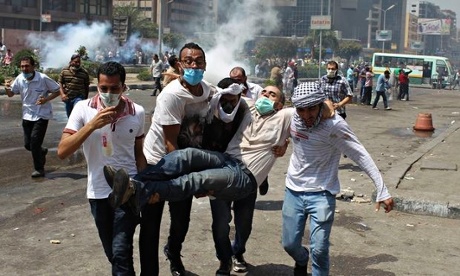
Clashes at Rabaa al-Adaiya, August 2013. 
Photograph: Asmaa Waguih/Reuters

Clich here for PART 1/2

At any one time, the third floor can hold well above 300 prisoners, with the total number of inmates likely to be higher, since some detainees have left and others have taken their places.


Amnesty believes that up to 20 have been released from any kind of custody. Lawyers also say that a number of others have “reappeared” in civilian jails, accused of terrorism charges based on confessions extracted after torture and interrogation.


The interrogation and systematic torture of Azouli’s prisoners takes place in a separate building – known as S-1 – a few minutes’ drive from the prison. About 10 prisoners are taken there at the middle of each day. Once their names are called, they are let out of their cells to blindfold themselves and form a line. Each survivor said that at this point they would be beaten then led downstairs to a minibus, where they would be beaten again. Prisoners are then driven the short journey to S-1, where they are usually led up a set of wooden stairs to a first-floor office. There the detainees wait – still blindfolded – until they are called one by one to a next-door room.


When Khaled was first called, on his first full day at Azouli, he remembers the unnerving sound of an officer silently flicking his lighter on and off for several minutes before asking a series of questions about the organisation of protests.


“And then the torture started,” Khaled recalled. “It started with electric shocks in every place in my body. [The officer] called the military policemen and told them: ‘Take off his clothes.’ They took me out of the room. I took everything off apart from my boxers. They said: ‘Make yourself totally naked.’ I said no. The officer said: ‘Bring him in.’


 “I started to give him some names. He felt I had lied, so he ordered the soldiers to make me totally naked. The electric shocks were in every place in my body, especially the most sensitive areas – my lips, the places with nerves. Behind the ear and lips. Under the shoulders.”


After the electrocutions, Khaled’s hands were tied behind him. He then claims he was hanged naked by the ensuing knot from a window frame – a torture technique known as the Balango method, which left his shoulders and wrists in excruciating pain. Two-and-a-half hours later he was taken down and returned to the cells.


Two other former inmates report similar experiences, though one says he was tied in a different position, and the other – Salah, a man in his 20s – said he was allowed to keep wearing his clothes while being electrocuted.


“The officer asked me if I knew certain people from a list,” said Salah. “If I said no, he would electrocute me … My answers were, of course, no: I don’t stay very much in [my hometown]. So he would electrocute me.


“The electrocution was over my clothes, but on the testicles. I was sitting on the floor, handcuffed. He was sitting on the small table, and would stretch his hands to electrocute me in my testicles.”


The victims cannot know for certain who tortured them. But all three believe that the interrogations were led by officers from military intelligence – the army wing headed until 2012 by Abdel Fatah al-Sisi, Egypt’s new president – with involvement from the secret police, known informally in Egypt as amn ad-dawla, or state security.


One interviewee said he had been brought to Azouli by state security, who handed him over to the army.


According to Ahmed Helmy, a lawyer who represents former Azouli prisoners, many detainees are tortured by military intelligence until they memorise specific confessions to acts of terrorism. Then they are transferred to state security offices where they are asked to repeat these confessions to a police prosecutor. Other detainees from civilian jails confirm meeting Azouli prisoners at this stage in their incarceration.


If they repeat their memorised confessions correctly, Azouli prisoners are then “reappeared” in a civilian jail, where torture is less systematic, and where they are allowed visits from lawyers and relatives. But, says Helmy: “If they don’t confess exactly how the security services want, they’re sent back to Azouli for more torture.”


Helmy represents some of the detainees who he says have been transferred from Azouli to civilian jails. He says some of them may have committed parts of the crimes to which they have confessed, but because of the way their confessions were extracted it was impossible to be sure.


“You can’t know if these people have committed these crimes or not,” Helmy said. “Under the pressure of torture you can admit to anything. It’s clear that some people are admitting to things because of the torture.”


The mother of one former Azouli detainee – now transferred to a civilian jail – said it had taken her son Omar four days of torture and three trips to a civil prosecutor before he would agree to recite his forced confession. Omar’s mother said she feared he had died because during his time at Azouli no state institution would reveal his whereabouts.


She only found Omar again when he re-emerged at an official jail weeks later. “The skin on his nose was raw to the bone,” she remembered of their reunion at a family visit inside the second prison.


 “There was a cut with the depth of a fingertip on his neck, which came from being beaten with a metal stick. There were two big wounds on his wrists from the hanging.


“They electrocuted him on his testicles. He said he was threatened with rape and that they used to hang them naked. He said he was prevented from going to the bathroom for six days and they kept him blindfolded for ten days.


“He asked me if we had had any visits, because they threatened that they would arrest his [female relatives], rape them, film it, and then show them the videos.”


The three former prisoners interviewed directly by the Guardian said that they were not tortured at S-1 as many times as detainees such as Omar. Over time, officials appeared to lose interest in them, which may partly explain their eventual release.


Summarising the difference between Azouli and notorious civilian jails such as Cairo’s Scorpion prison, Helmy said: “Scorpion is an official prison under the supervision of the prosecution and it’s visible. But Azouli is in a military area. It’s forbidden for any civilians to go inside.


“When we ask the civil prosecution to investigate people inside Azouli, they say they don’t have any jurisdiction to go there. So it’s a place where military intelligence can take their time and torture people without any oversight.”


At Azouli, prisoners subjected to systematic torture lack even a hypothetical legal redress.


“It gives you an idea of how confident the security forces are today,” said Amnesty’s Mohamed Elmessiry.


“They don’t care about the rule of law. They are holding people for over 90 days and subjecting them to ongoing torture without any judicial oversight. These practices are a devastating blow to detainees’ rights, as enshrined under both Egyptian and international law.”


As Khaled, one of the three survivors, summarised: “Your whole life there is a living tomb. No one knows anything about where you are.”


A senior military officer acknowledged the existence of Azouli prison, but did not respond within a fortnight to specific written allegations, and turned down a request to visit the jail.


Additional reporting by Manu Abdo. All detainees’ names have been changed.


The ‘security solution’


Azouli is one of the clearest examples of a resurgent security state that was never reformed under the successors to Hosni Mubarak (including the Muslim Brotherhood’s Mohamed Morsi, under whose presidency security officials were frequently accused of excessive force and torture) and in the past 12 months has exerted itself in almost unprecedented fashion.


Throughout last summer and early autumn, police and soldiers engaged in six mass killings of alleged Morsi supporters unmatched by any other in Egypt’s modern history. They began with the deaths of 51 Morsi supporters on 8 July 2013 and peaked with the clearance of a protest camp – Rabaa al-Adawiya– at which at least 637 died.


Post-Morsi governments have said the “security solution” is necessary to counter terrorism, a narrative made possible by a wave of jihadist-led bombings and ambushes in the Sinai peninsula – most notoriously, the assassination of 25 police conscripts in August. Islamist-led attacks on churches and police stations in the days after Rabaa also helped to justify it.


According to the interior ministry, at least 16,000 Egyptians have been arrested for political reasons since July 2013, though one independent estimate suggests the figure may be as high as 41,000.


As the interior minister, Mohamed Ibrahim, has admitted, many were arrested arbitrarily. “Every Friday, no less than 500 to 600 get arrested,” he said in January. “At the beginning, we used to wait for the demonstration to turn violent, but now we confront them once they congregate. When we confront them, there are some that run. But whoever we can grab, we detain.”


Most of the detainees are Morsi supporters. But the crackdown has widened to include anyone whose beliefs, actions or lifestyle threatens the state. Liberal academics have been banned from overseas travel, while those detained include allegedly gay men, at least 16 journalists and hundreds of secular activists, including figureheads of the 2011 uprising.


‘Bring him in.’


 “I started to give him some names. He felt I had lied, so he ordered the soldiers to make me totally naked. The electric shocks were in every place in my body, especially the most sensitive areas – my lips, the places with nerves. Behind the ear and lips. Under the shoulders.”


After the electrocutions, Khaled’s hands were tied behind him. He then claims he was hanged naked by the ensuing knot from a window frame – a torture technique known as the Balango method, which left his shoulders and wrists in excruciating pain. Two-and-a-half hours later he was taken down and returned to the cells.


Two other former inmates report similar experiences, though one says he was tied in a different position, and the other – Salah, a man in his 20s – said he was allowed to keep wearing his clothes while being electrocuted.


“The officer asked me if I knew certain people from a list,” said Salah. “If I said no, he would electrocute me … My answers were, of course, no: I don’t stay very much in [my hometown]. So he would electrocute me.


“The electrocution was over my clothes, but on the testicles. I was sitting on the floor, handcuffed. He was sitting on the small table, and would stretch his hands to electrocute me in my testicles.”


The victims cannot know for certain who tortured them. But all three believe that the interrogations were led by officers from military intelligence – the army wing headed until 2012 by Abdel Fatah al-Sisi, Egypt’s new president – with involvement from the secret police, known informally in Egypt as amn ad-dawla, or state security.


One interviewee said he had been brought to Azouli by state security, who handed him over to the army.


According to Ahmed Helmy, a lawyer who represents former Azouli prisoners, many detainees are tortured by military intelligence until they memorise specific confessions to acts of terrorism. Then they are transferred to state security offices where they are asked to repeat these confessions to a police prosecutor. Other detainees from civilian jails confirm meeting Azouli prisoners at this stage in their incarceration.


If they repeat their memorised confessions correctly, Azouli prisoners are then “reappeared” in a civilian jail, where torture is less systematic, and where they are allowed visits from lawyers and relatives. But, says Helmy: “If they don’t confess exactly how the security services want, they’re sent back to Azouli for more torture.”


Tuesday, July 28, 2015

EGYPT: In the balance, how far Egypt detoriarated under the Gunta rule.:


Do not wonder why Egypt's map is upside down. Read the following post


  • The population of Egypt is estimated at 83,386,739 as of July 1 2014.
  • Egypt's population is equivalent to 1.15% of the total world population.
  • Egypt ranks number 15 in the list of countries by population.
  • The population density in Egypt is 83 people per Km2.
  • 44% of the population is urban (36,713,659 people in 2014).
  • The median age in Egypt is 25.5 years.


·  

HUMAN RIGHTS

Egypt’s human rights crisis, the most serious in the country’s modern history, continued unabated throughout 2014. The government consolidated control through constriction of basic freedoms and a stifling campaign of arrests targeting political opponents. Former Defense Minister Abdel Fattah al-Sisi, who took office in June, has overseen a reversal of the human rights gains that followed the 2011 uprising. Security forces and an increasingly politicized judiciary—apparently unnerved by rising armed group attacks—invoked national security to muzzle nearly all dissent.

Judges routinely ordered detainees held for months based on little, if any, evidence. Thousands arrested after mass protests in 2013 remained in pretrial detention. Pervasive impunity characterized the government’s response to security force abuses. Only four officers have faced charges for human rights violations since July 3, 2013, when the military overthrew President Mohamed Morsy. All the charges stemmed from one incident in August 2013 in which police tear gassed a packed prison van, killing 37 detainees. There has been no accountability for the deaths of more than 1,000 protesters in a series of mostly peaceful demonstrations in July and August 2013.

Protester Killings and Impunity

 Security forces used excessive force to disperse protests early in the year. Nearly 20 people, most of them Morsy supporters, died in clashes with police in the first three days of January. On January 25, the third anniversary of the 2011 uprising, at least 64 demonstrators died in clashes with police in protests throughout the country.

Outgoing interim president, Adly Mansour, who handed over power to al-Sisi on June 8, established a presidential fact-finding committee in December 2013 “to gather information and evidence for the violent events” that accompanied the June 30 mass protests and July 3 coup that brought down Morsy, Egypt’s first freely elected president. An executive summary of the commission’s report, released on November 26, did not recommend that charges be brought against any member of the security forces or government for the mass killing. Its mandate did not authorize it to subpoena witnesses or documents, establish individual criminal liability, or make its findings public.

In March, Mansour asked the Justice Ministry to open a judicial investigation into the August 14, 2013, dispersals of pro-Morsy sit-ins at Rab’a and Nahda squares in Cairo in which more than 800 protesters died. The ministry announced it would not assign a judge to investigate these events because this was the prerogative of the prosecutor general, whose office claimed it was already investigating.

A March 18 court ruling sentenced a police captain to 10 years in prison and three lower-ranking officers to one-year suspended sentences for their role in the tear gas suffocation of 37 protesters in a police van outside Abu Zaabel Prison on August 18, 2013. An appeals court overturned the convictions on June 7 and referred the case to the prosecutor general for further investigation. A retrial is scheduled to begin on January 22, 2015.

Mass Arrests

An Interior Ministry official acknowledged in July 2014 that since Morsy’s ouster a year earlier authorities had arrested 22,000 people, most if not all suspected supporters of the Muslim Brotherhood. According to the Egyptian Center for Economic and Social Rights, more than 41,000 people were arrested or faced criminal charges between July 2013 and May 2014.

Judges routinely renewed detention orders of many of those arrested for months without charge or trial and convicted many others in mass trials without establishing individual guilt for criminal offenses. As of July 2014, according to Interior Ministry data provided to the presidential fact-finding committee, more than 7,000 people arrested in the fallout from Morsy’s removal remained in pretrial detention.

Those detained include around 29,000 Brotherhood members, including its high and mid-level leadership, according to the Brotherhood. The arrest campaign expanded in 2014 to include secular and leftist activists on charges that include protesting without authorization, incitement, “thuggery,” vandalism, blocking roads, and belonging to banned or “terrorist” groups.

Due Process Violations and Mass Death Sentences

 Egypt’s judiciary exhibited serious procedural deficiencies that deprived detainees of basic due process rights. Though authorities in November 2013 lifted the state of emergency imposed at the time of Morsy’s removal, judges often renewed pretrial detention orders despite a lack of evidence that would warrant prosecution.

Many trials violated Egyptian law as well as international standards. In March and April, a criminal court judge in the governorate of Minya handed down the death penalty to more than 1,200 people allegedly involved in two attacks on police that resulted in the death of one officer. The judge did not allow the defendants the right to mount a meaningful defense or ensure that all had access to counsel.
The first trial, which resulted in 529 death sentences, lasted less than an hour, and only 74 defendants were present. The court also barred some defense lawyers from attending. In the second trial, which yielded 683 death sentences, none of the defendants attended.

Following legally mandated advice from the grand mufti, Egypt’s top religious authority, the judge confirmed 220 of the death sentences, which the prosecutor general automatically appealed as required by law. In December, a separate judge in the governorate of Giza issued preliminary death sentences to 188 people accused of attacking a police station in August 2013 and killing 14 policemen. According to the Brotherhood, 259 of its members, including Supreme Guide Mohamed Badie, have been sentenced to death since Morsy’s ouster.

Egypt’s 2014 constitution permits military trials for civilians, and on October 27, 2014, al-Sisi issued a decree expanding military court jurisdiction to cover crimes that occur on any public, state-owned, or “vital” property. Since the decree, prosecutors have referred at least 455 people—the vast majority of them Brotherhood members—to military court. In April, a military court sentenced a social media manager for the online news website Rassd to one year in prison for helping to leak a tape of remarks by al-Sisi during his time as defense minister. The court acquitted one Rassd employee and handed down three-year sentences to an army conscript and two other men who remain at large. In May and September, military courts handed down one-year sentences to 10 people—most of them Brotherhood members or allied politicians—for attempting to cross into Sudan illegally. In November, a military court in Suez sentenced 17 people to between 5 and 10 years in prison for throwing rocks and incendiary devices at soldiers during the violence following Morsy’s removal.

Torture and Ill-Treatment

At least 90 people died in local police stations and security directorates in the governorates of Cairo and Giza alone in 2014, according to an investigation by the Egyptian newspaper Al Watan, which cited statistics from the Justice Ministry’s Forensic Medical Authority. That number represented a 38 percent increase from the year before.

A spokesman for the authority told the newspaper that prison overcrowding had forced authorities to hold detainees in police stations and other places of temporary detention which were not well ventilated or otherwise properly equipped. Witnesses told Human Rights Watch that police and prison authorities often failed to provide proper medical care to prisoners, leading to death. In some cases of deaths in detention, lawyers and relatives alleged that authorities had tortured the victim.

Detainees also described severe beatings during arrest, arrival at police stations, and transfer between prisons. Scores detained in January protests complained of torture, including electric shocks, to coerce confessions. The Egyptian Initiative for Personal Rights documented the enforced disappearance and torture of dozens of civilians in military detention.

Attacks by Armed Groups

 The security situation deteriorated, particularly in the Sinai, as armed groups targeted security forces, buildings, checkpoints, and vehicles. An Egyptian insurgent group, Ansar Beit al-Maqdis, announced that it has joined the extremist group Islamic State (also known as ISIS). Some attacks targeted tourists or indiscriminately harmed ordinary citizens. At least 892 people—including militants, civilians and security forces—died in the governorate of North Sinai in 2014, according to press reports.

Freedom of Association, Expression, and Assembly

 Egypt’s new constitution contains language that appears to protect free expression, peaceful assembly, and association, but authorities detained thousands solely for their peaceful exercise of these rights.

Free Expression

Authorities detained dozens of people for such offences as possessing flyers with anti-military slogans, rapping in public against the police, or displaying signs commemorating victims of the Rab’a dispersal. Journalists, academics, former lawmakers and human rights defenders were among those charged with crimes or banned from travel outside Egypt. Police arrested three Al Jazeera English journalists, Mohamed Fahmy, Peter Greste, and Baher Mohamed, in late December 2013, and a court handed down multi-year prison sentences in June 2014 after a trial in which prosecutors failed to present any credible evidence of criminal wrongdoing.

Free Assembly

 A November 2013 law on public assembly allowed the Interior Ministry to ban and forcefully disperse protests and arrest participants on vague grounds such as “imped[ing] citizens’ interests.” On April 7, 2014, a court rejected appeals from April 6 Youth Movement co-founders Ahmed Maher and Mohamed Adel and activist Ahmed Douma against their three-year sentences for breaking the law. Authorities also used the law to detain prominent activist Alaa Abdel Fattah and human rights defenders Mahienour al-Masry and Yara Sallam.

Free Association

In September 2014, al-Sisi signed an amendment to the penal code that mandates a life sentence and a fine of 500,000 Egyptian pounds (US$69,900) for anyone who takes foreign funding to harm the national “interest” or “unity,” a provision Egyptian rights activists fear will be used against them and other nongovernmental organizations (NGOs).

Authorities banned the Muslim Brotherhood and declared it a terrorist organization in December 2013, following a bomb attack on a Nile Delta police station claimed by Ansar Beit al-Maqdis. Authorities put forward no evidence to support the designation, but in a television statement Deputy Prime Minister Hossam Eisa cited as justification the 1948 assassination of Egypt’s prime minister and the alleged torture of Brotherhood opponents during the pro-Morsy sit-ins in July and August 2013. Authorities froze the assets of more than 1,000 associations allegedly tied to the Brotherhood, such as the Islamic Medical Association, which served residents of poor neighborhoods, in addition to dozens of Brotherhood-affiliated schools.

On April 28, the Court of Urgent Matters banned activities of the April 6 Youth Movement and authorized the authorities to shut its headquarters on grounds that it engaged in espionage and harmed Egypt’s image abroad, based on a complaint from lawyer Ashraf Said, who said recorded phone calls among April 6 members aired on television “proved” the activists had “conspired against state institutions.”

Authorities raided the Alexandria office of the Egyptian Center for Economic and Social Rights on May 22, briefly arresting at least 15 activists and lawyers and subjecting them to sexual harassment and beatings. Riot police and military troops also broke up labor protests and strikes.

The Social Solidarity Ministry in June 2014 presented a draft law on associations that would give the government security agencies veto power over NGO activities as well as their registration and funding. The law would also cripple their capacity to communicate or co-operate with groups abroad.

The Social Solidarity Ministry did not enforce a November 10 deadline for all NGOs to register under the current Law of Civic Associations and Foundations (Law 84 of 2002), which would give the government tight control over their activities. Many Egyptian human rights organizations are currently registered as civil companies or law firms due to the highly restrictive law. However, several high-profile human rights defenders left the country fearing arrest and prosecution, and some groups suspended their activities. The government has pledged to make the NGOs register.


Freedom of Religion and Sectarian Violence

 Egypt’s 2014 constitution guarantees freedom of religion and the rights of minorities, but authorities continued to prosecute writers and activists on charges of “contempt of religion” and “blasphemy,” including religious minorities and proclaimed atheists. In June, an appeals court in the governorate of Beni Suef upheld a five-year sentence in absentia for author Karam Saber, a Muslim convicted for contempt of religion in 2013 for his short story collection Where Is God? Attacks on churches and properties of Christians continued in 2014, and in many cases authorities failed to intervene. 

Violence and Discrimination against Women

Sexual harassment and assault of women and girls in public spaces continued in spite of recent government efforts to combat the practice, including arresting and prosecuting some men for such crimes, which have long been committed with impunity.

Egyptian rights groups documented at least nine incidents of mob sexual assault and harassment in Cairo’s Tahrir Square between June 3 and June 8, 2014, as demonstrators celebrated al-Sisi’s election. Seven men were eventually handed sentences ranging to life for the attacks, and interim President Mansour issued a law on June 5 that for the first time defined and outlawed sexual harassment and set escalating penalties for different offenses.

Al-Sisi ordered the formation of a ministerial committee to determine a national strategy to address harassment. On June 12, the committee met and proposed plans that included increasing security for women in public squares and gatherings, as well as raising awareness about harassment against women through media campaigns and schools. The committee has not proposed a comprehensive law on violence against women nor a national strategy to implement such a law.

No law criminalizes domestic violence. Other forms of violence against women, including child marriage and female genital mutilation (FGM), continued in some areas, despite laws prohibiting them. On November 20, the country’s first trial for FGM, which began after a 13-year-old girl died from an allergic reaction to penicillin, ended in an acquittal for the girl’s father and the doctor who performed the procedure. The prosecutor appealed the acquittal. Personal status laws in Egypt continue to discriminate against women in relation to marriage, divorce, child custody, and inheritance.

Refugees, Asylum Seekers, and Migrants

Egypt violated the rights of refugees, asylum seekers, and migrants within its borders. Syrians represent one of the largest refugee populations, with nearly 140,000 registered with the United Nations High Commissioner for Refugees (UNHCR). Egypt prevented the UNHCR from registering Palestinians from Syria, and security officials maintained a restrictive visa and security clearance requirement enacted following the ouster of Morsy. In some instances authorities coerced refugees from Syria to leave to Lebanon, without assurances they would be protected there, and to Syria, where they face persecution, detention, and violence.


Egypt,  where are you taken to?